Q&A with Nina Weber, Chief of Staff at Rail-Flow.
Nina Weber, Chief of Staff at Rail-Flow, shares how she bridges strategy and execution across teams, why Fellow and Claude are her go-to AI tools, and where she sees the biggest opportunity for process-driven growth.
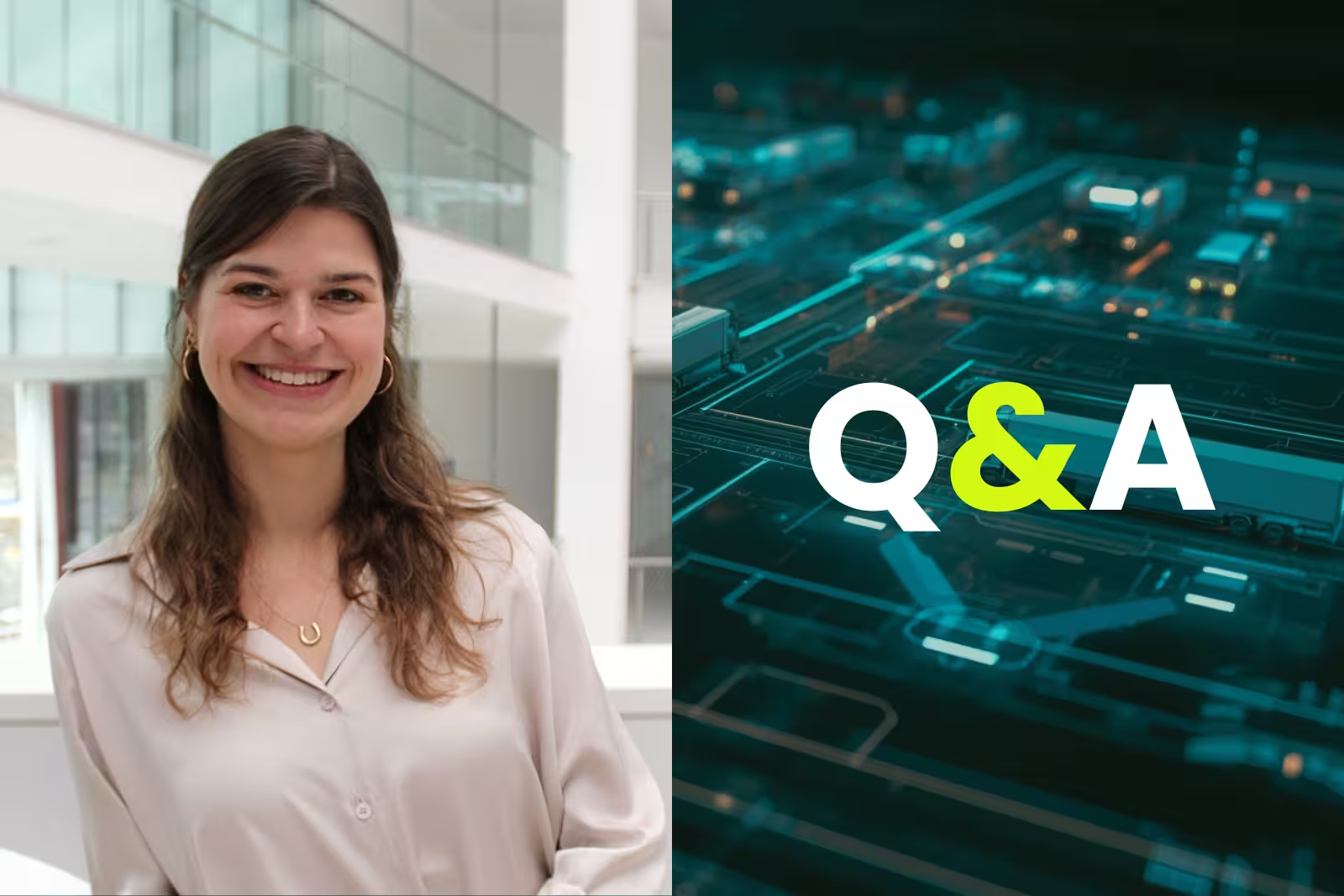
Nina Weber works at the intersection of worlds that, in most companies, rarely meet: strategy and execution, the executive team and the people shipping the day-to-day work, the long arc of company goals and the messy reality of getting things over the line. We sat down with Nina to talk about what a Chief of Staff actually does behind the scenes, how she keeps focus between a hundred competing inputs, which processes she loves and which she would happily rebuild, and the tools that get her through an hour rather than a day.
Most people know you oversee “strategy and OKRs,” but what the role actually looks like day to day is a bit of a mystery. Can you take us behind the scenes?
I like to describe the role as a bridge: between departments, between different opinions, between strategy and execution. Honestly, also the go-to person for just about everything. On paper that means I’m responsible for OKRs, for investor relations, and for extending capacity on internal projects, like the IT admin transition we’re rolling out right now.
The part people don’t see is how much of it is simply talking to people. I’m constantly gathering input from across the company, and because of that I get to see connections that aren’t visible from inside any single team. A lot of my job is taking all of those threads and turning them into something the leadership team can actually act on.
What’s your favorite AI tool at the moment, and why?
There are two I’m using most right now, and it’s really the combination of them that I’d call my favorite: Fellow and Claude.
Fellow does a lot of the heavy lifting around meetings, writing the minutes and capturing the tasks that come up while everyone’s still talking. Claude is where I turn that raw material into actual output. Between the two of them, I’m reaching for these tools on an hourly basis, not just a daily one.
Which internal process do you like most, and which one do you wish you could redesign?
Let me take the difficult one first. The process I’m least happy with right now is the OKR process itself. It works, and I do like the idea of it. Still, there’s real room for improvement, which Arianna Lopez, our working student in Business Administration, and I are actively working on. A lot of it comes down to the mechanics: the performance and load times of the Confluence pages, the friction in the workflow. It’s a big process, and big processes need maintenance.
The one I genuinely enjoy is almost the opposite. Gathering input for all the different meetings can feel tedious, because I have to chase a lot of people for a lot of things. But that’s exactly why I like it. It’s what puts me in conversation with so many people, and it’s where I end up spotting connections I wouldn’t have seen otherwise.
What’s your vision for taking Rail-Flow to the next level? Where do you see the biggest growth opportunities?
The first thing that comes to mind is very close to my own role: process optimization. Not only inside the engineering department, but across all the administrative parts of the company too. I think AI can help us enormously here, and it’s a genuine step-up opportunity.
It can sound a little contradictory, since more processes sounds more corporate, not more agile. But I’m convinced that having clear, well-defined processes, and clarity on who is responsible for what, is exactly what unlocks agility for us. And then AI on top of that, helping not just in the product but in our internal steering and projects.
Bonus question: We’ve had to update our address books from Nina Gattermeyer to Nina Weber. Congratulations on getting married! Did you manage to take a honeymoon despite this demanding period of growth at Rail-Flow?
Thank you so much! We decided to be strategic about it: our honeymoon is scheduled for next winter, trading the German grey for some sunshine and proper adventure. We’re already counting down the days!