Q&A with Jessica Syroka, Business Analyst at Rail-Flow
She works where user needs and code meet: between the roadmap, the customers and the developers, who turn ideas into product features.
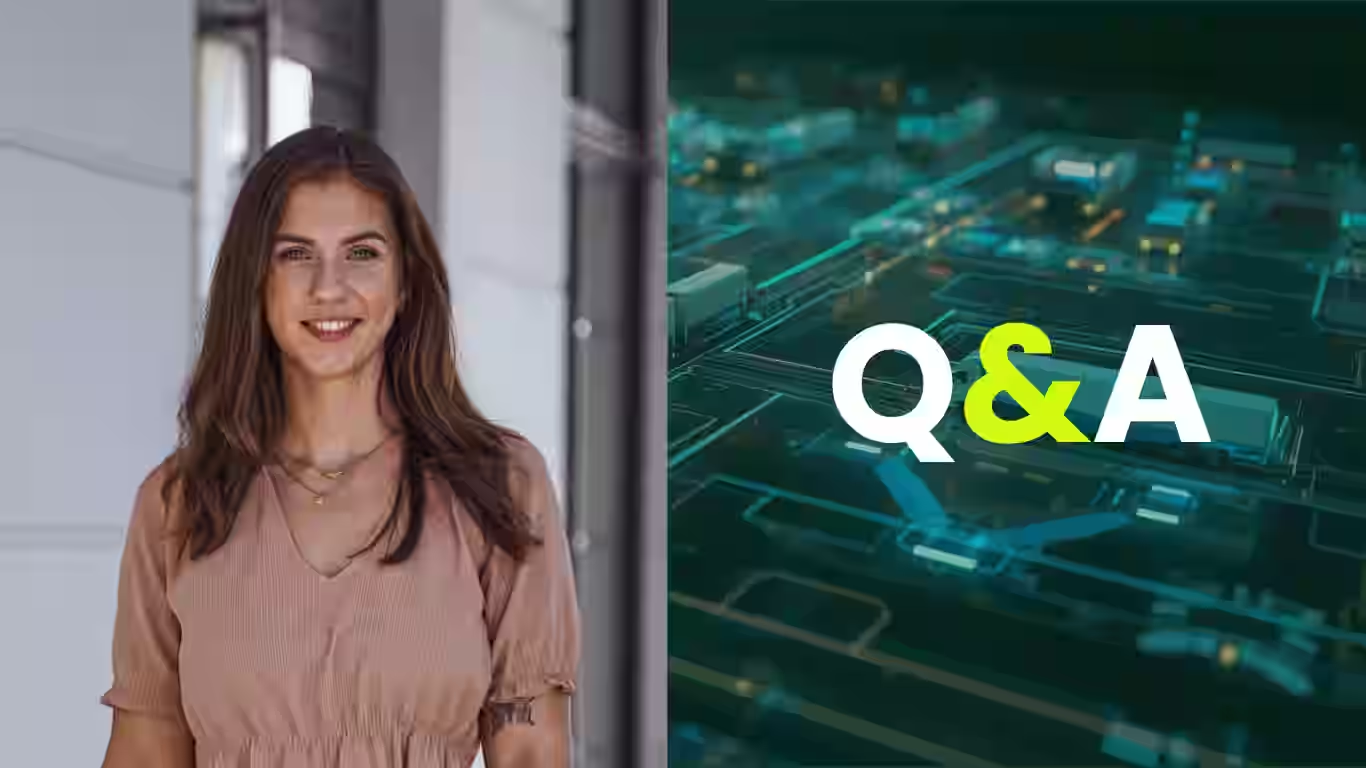
Jessica Syroka, Business Analyst at Rail-Flow, talks about how goals on the product roadmap turn into concepts the development team can build on, how AI speeds up her first drafts and how she turns the variety of customer needs into one interface that works for everyone.
Jessica works where user needs and code meet: between the roadmap, the customers and the developers, who turn ideas into product features. We spoke to Jessica about what a Business Analyst actually does behind the scenes, how a concept becomes a feature, what she is working on right now and why she calls the new Rail-Flow app her latest “baby”.
Many people know the title “Business Analyst”, but what the role looks like day to day is less obvious. Can you give us a look behind the scenes?
I have been at Rail-Flow for two years. I started in the Rail Transport Management System (RTMS) team and was a Business Analyst from day one, with a focus on UI/UX design. That is where I come from: before Rail-Flow, I worked as a UI/UX designer in road transport, tracking and IT for logistics platforms, and I brought that experience into rail freight.
At its core, my job is concept work. I take the next topics from the roadmap and start by looking at what the goal actually is from the customer’s perspective. If that is not entirely clear, I begin with what I learned in UI/UX as the empathise phase: what does it look like today, what is missing, where is the pain point? For that, I also get direct customer feedback. The result is a concept that serves as the single source of truth for development: the why, the current state, what we want to solve and, above all, what it should look like for users, mapped out in clickable dummies and prototypes.
What role does AI play in this process?
Today I develop my concepts with the support of AI. From the context and the idea, the first draft takes shape within just a few hours. With alignment and rework, a concept usually takes a few days, sometimes a little longer for complex topics.
Once a concept is finished, we hand it over to development. The developers either read it or pass it on to the AI as a starting point and write and review the code on that basis. It is still a team effort, though: there are often questions or feedback, and we stay in close contact. The whole thing runs asynchronously, so while one concept is being developed, I am already working on the next one.
What is the biggest challenge in your work?
The real challenge in UI/UX design is less about technology and more about people: every customer brings their own processes, workflows and habits, and we want the interface to feel natural for all of them. A button that sits in the right place for one team may not match the reading direction another team is used to. This is exactly where Oracle APEX, our development environment, works in our favour. Its components come with proven, predefined behaviour, which gives us a stable foundation, and the latest APEX update has given us even more flexibility to customise on top of it. We are already using it, and as part of an AI pilot project we are already putting that flexibility to use. Our users can look forward to an even more intuitive interface!
Our ambition is to reflect each customer’s processes as closely as possible, and at the same time to build solutions that work for the whole community of users. That is a deliberate choice: one well designed solution improves with every customer who uses it, whereas ten separate variants in one platform would mean none of them evolves. So the real craft is finding the best solution for as many customers as possible without adding unnecessary complexity.
What are you working on right now?
Most recently, I reworked the bulk edit, the mass editing tool for origin destinations in Purchase & Tender Management (PTM) and Rail Offer Management (ROM). Think of it like Excel: columns instead of form fields. Customers had contributed further ideas, which we have now built into the concept, and it is currently with development.
Next up are customisable fields. This is about which additional fields a requester wants included in the provider’s response, for example CO2 emissions or other individual fields that give even more precise answers.
Bonus question: you call the new Rail-Flow Go app your latest “baby”. What can you tell us already?
Rail-Flow Go is now in its final stage and ready for handover. It all started with simple screen designs, and I shaped how the app looks from the very first screen designs. It has since become a real app. Since Rail-Flow Go is based on Purchase & Tender Management and Rail Offer Management, it gets the new Rail-Flow corporate design together with those products.
Rail-Flow Go will soon be available in the App Store and on Google Play. Stay tuned!