After a successful pilot phase: Rail-Flow continues the Resource Sharing Broker on its own
Frankfurt am Main, 12. Oktober 2026. With the Resource Sharing Broker (RSB), Rail-Flow GmbH has developed a digital platform that enables rail freight operators to rent and rent out locomotives at short notice by the day, week or month. Most participating companies use both roles: they cover short-term demand and at the same time rent out their own vehicles that are temporarily idle. The RSB was created over a two-year development and pilot phase together with the project partners Fraunhofer Institute for Material Flow and Logistics IML and BELog Baustoffe-Entsorgung-Logistik GmbH & Co. KG. The platform is now moving permanently into regular operation.
Key Takeaways
- Short-term, demand-driven locomotive rental as a complement to established long-term leasing
- The marketplace digitally maps the entire rental process, from request to return
- Most participating companies act in both roles, as lessors and as lessees
- A growing three-digit number of participating companies is already connected
More flexibility in locomotive rental
Demand for this is growing. As established players hand over traffic and private rail freight operators take on more and more volume, the need for flexible rental alongside established long-term leasing is rising. Short-term traffic peaks and an increase in spot traffic are becoming the rule rather than the exception for a growing number of companies. Added to this is the classic use case of a temporary shortfall in locomotive availability, for example due to unexpected locomotive failures, extended workshop downtimes or delayed vehicle deliveries.
At the same time, capacity that is urgently needed elsewhere remains unused, and this in a market that expects to return to growth in the medium term after the current decline in train-path kilometres. On average, locomotive utilisation in rail freight is below 70 per cent. This is exactly the gap the RSB addresses: it brings together available vehicles and short-term demand and turns idle locomotives into available capacity and revenue.
“As a rail freight operator with our own fleet, we know both sides: we need additional locomotives at short notice and at the same time have vehicles that are temporarily unused. The RSB finally gives us a tool that maps the entire process, from request to return,” says Timo Pape, General Manager of BELog Baustoffe-Entsorgung-Logistik GmbH & Co. KG.
A marketplace for the entire rental process
Around two years passed from the first idea to the live platform. In December 2024, a Minimum Viable Product (MVP) went live, followed in July 2025 by the Minimum Marketable Product (MMP) with an extended range of functions for productive use. Several customer workshops were held along the way, in which standard contracts and checklists for vehicle handover, among other things, were developed and continuously refined together with lessees and lessors.
Today, the RSB digitally maps the complete process of a short-term locomotive rental: from the request through offer comparison and contract negotiation to the digital handover and return of the locomotive by checklist. Lessors can use their own, flexibly designed pricing models, while lessees can filter requests specifically by locomotive type or locomotive type group as well as by technical characteristics. Operating conditions allow special requirements or restrictions to be defined, confirmed or rejected quickly. The process is complemented by an in-app chat, central document management, a price comparison function and templates for recurring requests. Special cases such as subletting and contract extensions are also covered.
“For a long time, short-term locomotive rental was a business of phone calls, emails and Excel lists. With the Resource Sharing Broker, we have turned it into a lean digital process that leads to a contract in hours rather than days,” says Dominik Fürste, Co-CEO of Rail-Flow GmbH. “The fact that we are continuing to operate the platform on our own after the end of the funding is, for us, the real seal of quality: the market needs it, and that is why it stays.”
The RSB does not replace the personal networks and business relationships that have grown in the industry, it extends them. Users reach their existing network even faster than before and also gain straightforward access to further potential lessors and lessees who would not be reachable through personal contacts alone. In the two years since the start of the pilot, the platform has already developed into a live marketplace with a growing three-digit number of participating lessees and lessors.
“Access to spare capacity is crucial for utilisation in rail freight. The Resource Sharing Broker shows how a research approach can be developed into a functioning two-sided marketplace that delivers measurable benefits to lessors and lessees,” says Sandra Jankowski, Research Associate in the Transport Logistics team at the Fraunhofer Institute for Material Flow and Logistics IML.
Resource Sharing Broker in permanent regular operation
The development was made possible by funding from the German Federal Ministry of Transport (BMV) under the federal programme Zukunft Schienengüterverkehr (Z-SGV). The funding ended as scheduled on 30 September 2026. With Rail-Flow continuing the Resource Sharing Broker independently in regular operation, the solution developed in the project will remain permanently available on the market.
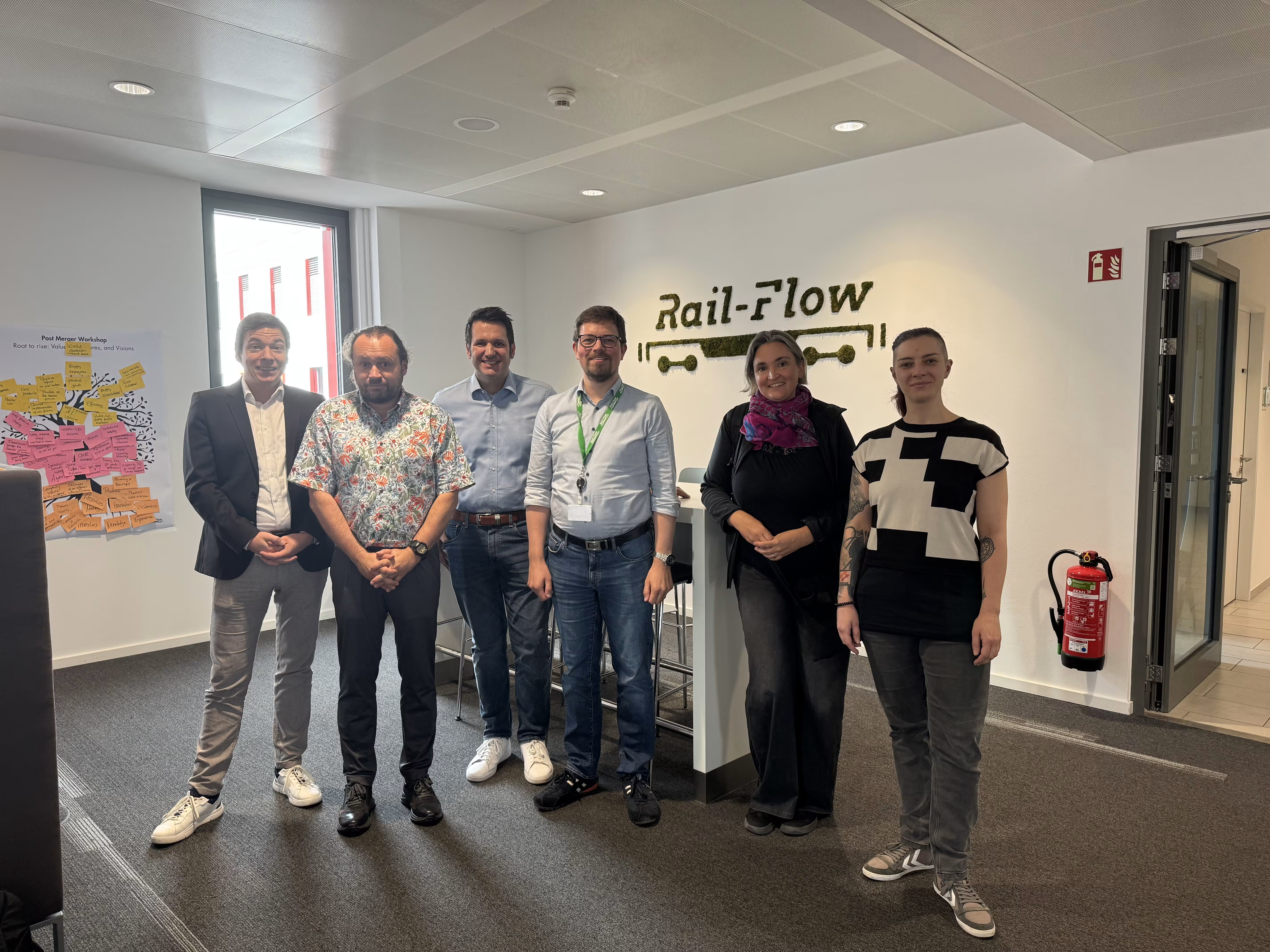
Photo caption (from left to right): Timo Pape, General Manager, BELog; Danny de Schultz, Z-SGV team at the DZSF; Christopher Smith, Project Manager RSB at Rail-Flow; Jochen Schäfer, Senior Funding & Partner Manager at Rail-Flow; Julia Bräutigam, Z-SGV Programme Officer at the DZSF; Sandra Jankowski, Research Associate at Fraunhofer IML.
Read more about the project